- National AAAAA level tourist attractions, national level scenic spots, and national key cultural relics protection objects
Buddhist Culture
Cliff Carving Scripture
Time:2025-07-09 10:06:43 Hit:4359
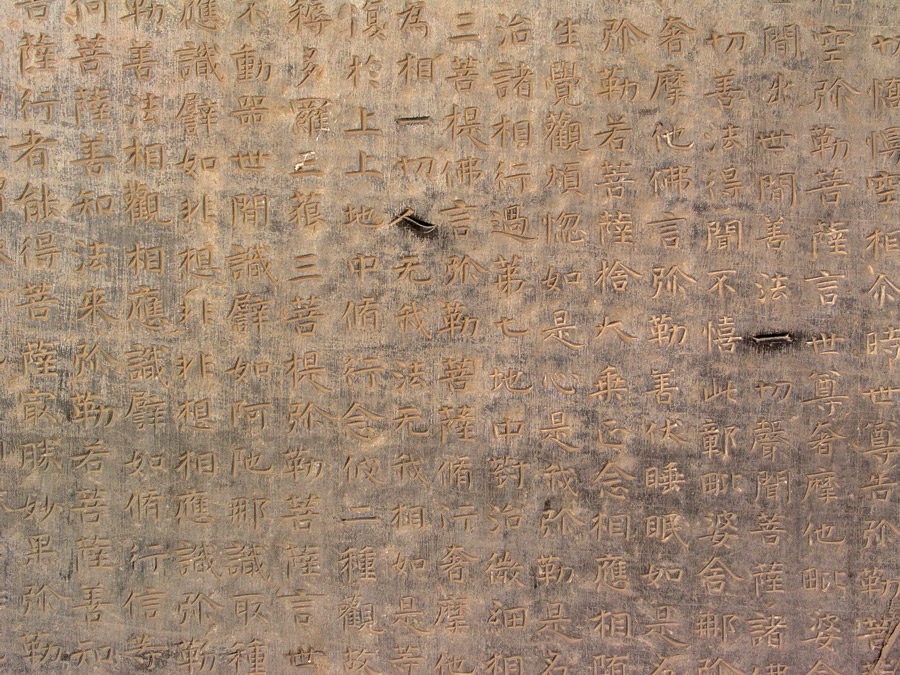
Nü wa Palace was carved and carved during the Tianbao period of the Northern Qi Dynasty, with a history of more than 1450 years. There are six scriptures carved in five places on the cliff, with a total area of 165 square meters and more than 137400 words of scriptures. From south to north, they are the Sutra of Siyi Brahma's Questions, the Sutra of the Ten Realms, the Sutra of the Buddha's Legacy, the Sutra of the Buddha's Discourse on the Obon, the Sutra of Deep and Profound Liberation, and the Lotus Sutra of the Marvelous Dharma. The Universal Door of Avalokitesvara.
The main fonts used for calligraphy are regular script, clerical script, and Wei stele. The calligraphy industry's evaluation of it is: "The font is mixed with regular script and clerical script, the body is smooth and elegant, and the brush strokes are enveloped in a Zen style scroll atmosphere." Its powerful and flowing Wei style calligraphy has been loved by generations of calligraphers and is praised as "silver hook and iron painting, unparalleled in the world.
The Chinese Buddhist scriptures have had a significant impact on the development of literature, writing, calligraphy, and translation in China. Especially in the translation of Buddhist scriptures, vernacular Chinese and simplified characters have emerged, and new vocabulary has been added. Simplified characters include "wan" and "wu", while new vocabulary includes "prajna" and "yoga". Early handwritten Buddhist scriptures are now rare, and these carved scriptures have become an important basis for academic research.
The main fonts used for calligraphy are regular script, clerical script, and Wei stele. The calligraphy industry's evaluation of it is: "The font is mixed with regular script and clerical script, the body is smooth and elegant, and the brush strokes are enveloped in a Zen style scroll atmosphere." Its powerful and flowing Wei style calligraphy has been loved by generations of calligraphers and is praised as "silver hook and iron painting, unparalleled in the world.
The Chinese Buddhist scriptures have had a significant impact on the development of literature, writing, calligraphy, and translation in China. Especially in the translation of Buddhist scriptures, vernacular Chinese and simplified characters have emerged, and new vocabulary has been added. Simplified characters include "wan" and "wu", while new vocabulary includes "prajna" and "yoga". Early handwritten Buddhist scriptures are now rare, and these carved scriptures have become an important basis for academic research.
Recommended News